

By Juan Mazzini, Global Head of Celent —
Artificial intelligence is no longer a “future of insurance” headline. It is already reshaping how carriers, reinsurers, brokers, and MGAs build products, run operations, and make decisions. The real question now is not whether AI will matter, but how quickly organizations can translate it into measurable outcomes—without breaking trust, compliance, or culture.
During Reinsurance Week Miami 2026, I had the chance to moderate and contribute to a panel organized by MIA Hub and hosted within a dedicated space built for the week by BlueCap. The panel brought together our perspectives across technology, operations, and people, with the key participation of Alejandro Ceron, Founder of SP&E Consulting; Antonio Lizano, Regional Director LATAM at Sunlight Solutions; and Ivan Hernandez, CEO of Rocket Code.
Below are the most practical themes that emerged—especially relevant for insurers, reinsurers, and brokers/MGAs looking to move from experimentation to enterprise value.
1. The biggest obstacle isn’t the model—it’s problem definition
A recurring point: many AI initiatives still start with a vague mandate (“we need AI”) rather than a crisp business problem. That leads to pilots that look impressive but don’t change outcomes.
The organizations getting traction are the ones that start by answering:
- What exactly are we trying to improve—cycle time, expense ratio, loss ratio, fraud leakage, customer satisfaction, retention?
- Where does automation help, and where does human judgment remain essential?
- What will we measure, and what will we stop doing if the initiative doesn’t deliver?
Just as important is the uncomfortable twin question: what should not be automated—whether for regulatory, ethical, or customer-experience reasons.
2. Data reality in LATAM: fragmentation is the tax you pay before AI delivers
AI is only as useful as the data foundation beneath it. In Latin America especially, the panel highlighted familiar constraints:
- data spread across multiple cores and platforms,
- critical information still living in PDFs or unstructured documents,
- slow manual aggregation to get a “good enough” view for decision-making,
- limited real-time 360 visibility across customer, policy, claims, and distribution.
If AI is the engine, data architecture is the runway. Without it, organizations may only succeed at one thing: accelerating inconsistency.
3. Where AI is already changing systems: build, configure, and test—faster than we’re used to
A practical systems takeaway is that AI’s most immediate impact isn’t just customer-facing chat. It’s inside the technology lifecycle:
(I) Code generation and automated testing: AI-assisted development compresses build cycles. Automated test generation and execution can reduce the pain (and time) of core implementations and customizations, improving release cadence and lowering delivery risk.
(II) Configuration and parameterization: In modern platforms, rules and product definitions can be externalized and configured rather than hard-coded. AI can accelerate that configuration—often by generating a first version and then prompting users for missing parameters (rates, commissions, eligibility, limits, exclusions).
The implication is meaningful: the time-to-market for product changes shrinks, and “configuration effort” becomes less of a bottleneck.
(III) Process enablement: Once systems can be changed faster, the organization can revisit processes more frequently—moving from “annual redesign projects” to continuous improvement.
4. Processes won’t just be automated—they’ll become adaptive
One of the strongest ideas discussed: the real transformation comes when processes stop being static diagrams and start behaving more like living systems.
As organizations capture richer operational data (handoffs, exceptions, turnaround times, leakage points), AI can:
- observe process performance continuously,
- surface bottlenecks and compliance risks,
- recommend changes,
- and, over time, enable self-improving loops.
That is a different ambition than classic automation. It’s not “do the same process faster.” It’s evolving the process itself based on evidence.
5. Parametric and real-time signals: the promise of “claims while you sleep”
When you bring together APIs, sensors, and triggers, parametric models show what operational “autonomy” can look like:
- the trigger occurs (weather, satellite, IoT, logistics),
- the system validates conditions,
- the core processes the event even outside business hours,
- and payout execution can be near-immediate—subject to governance and controls.
The broader point: AI isn’t the only technology that matters. Integration, event-driven architectures, and real-time data capture are equally critical to unlocking next-generation operating models.
6. People impact: the rise of “Bring Your Own AI” (and a new productivity baseline)
The panel emphasized that work velocity has changed. Just as enterprises went through “Bring Your Own Device,” we are entering a “Bring Your Own AI” era:
- hiring will increasingly evaluate how candidates use AI tools,
- teams will develop new norms around AI-supported drafting, analysis, and decision prep,
- and productivity expectations will reset.
This also creates organizational tension: in some tasks, **AI-enabled junior talent can outperform experienced staff **operating without AI support. That doesn’t diminish expertise—it forces companies to redesign:
- training paths,
- quality control,
- accountability,
- and how expert judgment is applied (and taught).
7. The long-term risk: if AI automates the “entry-level learning,” how do we create future experts?
A forward-looking question raised during the discussion: many professions develop expertise by doing repetitive work early—drafting, summarizing, building reports, processing basic cases. If AI absorbs that layer, how will we train the next generation of underwriters, claims leaders, and brokers?
This doesn’t argue for slowing AI down. It argues for redesigning capability-building:
- structured apprenticeship and case-based learning,
- simulation environments,
- expert review loops,
- and explicit training on how to question AI outputs, not just consume them.
In regulated industries, the ability to validate, explain, and defend decisions may become the defining professional skill.
8. Culture is the multiplier: leadership, collaboration, incentives
If AI adoption is treated as an “IT project,” it will stall. The panel aligned on three levers for culture change:
1. Leadership that uses AI personally and visibly – Not just approving budgets—actually integrating AI into decision-making workflows and encouraging teams to challenge assumptions with it.
2. Cross-functional collaboration – AI exposes seams between functions (underwriting, claims, legal, distribution, operations, IT). Reducing friction at handoffs is as valuable as model performance.
3. Incentives that reward adoption and responsible experimentation – Organizations need to recognize the behaviors that make AI useful: documenting learnings, building reusable prompts/agents, improving processes, and escalating risks early—within governance boundaries.
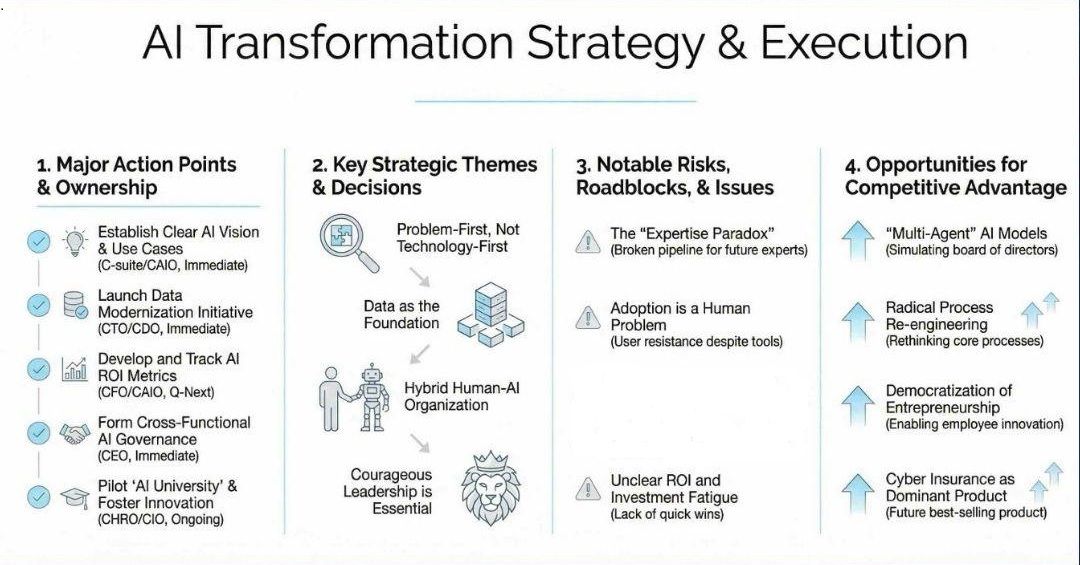
Closing thought: AI won’t differentiate you—implementation maturity will
Within a few years, access to AI will be commoditized. What won’t be commoditized is the ability to:
- define the right problems,
- build data foundations,
- implement with governance,
- redesign processes,
- and evolve culture fast enough to capture value.
That is where competitive advantage will sit for insurers, reinsurers, and brokers/MGAs.
About the Author
Juan Mazzini is the Global Head of Celent and also leads the insurance practice for EMEA, APAC, and LATAM. He is responsible for global research and advice to C-level executives in the financial services industry, on themes such as fintech, insurtech, innovation, emerging technologies, and business transformation. He has been part of and has accompanied the launch and evolution of various innovative initiatives and business models in the financial services industry, including the first reinsurance exchange in Latin America, a direct insurance brand in the .com era, and most recently, the design and construction of a digital direct insurer, and supporting the tech strategy for various greenfield operations in (re) insurance for all lines of business.
About Celent
For over 20 years, Celent has helped senior executives make confident decisions around their technology strategies to execute at scale. As the financial services industry rapidly evolves, there is more complexity, with new regulations, startups, technologies, and applications to stay on top of and prioritize. Celent helps you connect this ever-changing puzzle. We offer objective advice and clarity, backed by a database of thousands of solutions and award-winning global best practice use cases. With real-life domain expertise, we also guide you through the maze of emerging tech in the pursuit of value. Our people, data, insights, and relationships form the foundation for you to use Celent to make confident technology decisions in financial services. We are now a part of GlobalData. For more information, visit celent.com.
SOURCE: Celent


