

- Homes protected against extreme weather are selling for more, with price premiums ranging from 2.8–5.6%
- Resilience features (such as backwater valves, sump pumps, or hail-proof shingles) only add value when they’re clearly named in listings
- The majority of Canadians believe adaptation is worth it: 56% would pay more for mitigation features
- Most renovations cost less than the value they add
- Government rebates and subsidies can reduce up-front costs
Toronto, ON (June 27, 2026) – As Canada faces more frequent floods, fires, and severe storms, homeowners are increasingly looking for ways to protect their properties. But climate-resilient home upgrades aren’t just about protection, they’re starting to influence real-estate values. A recent study by the Institute for Catastrophic Loss Reduction (ICLR) shows that features like hail-proof shingles or a hail-roof, backwater valves, and other resilience measures are becoming selling points in cities across the country.
In places like Calgary, Edmonton, and Toronto, these upgrades are adding 2.8–5.6% to home prices—roughly $20,000–51,500 in additional value. These benefits often far exceed the cost of installation.
But most homeowners don’t realize these features add value and many listings fail to mention them at all.
A recent analysis of listings in Toronto, Calgary, and Edmonton by ICLR found five-figure price lifts when adaptation features were clearly mentioned—consistent with what buyers say they’ll pay once they understand the value.
Here’s a breakdown of how much resiliency measures can increase a home’s value:
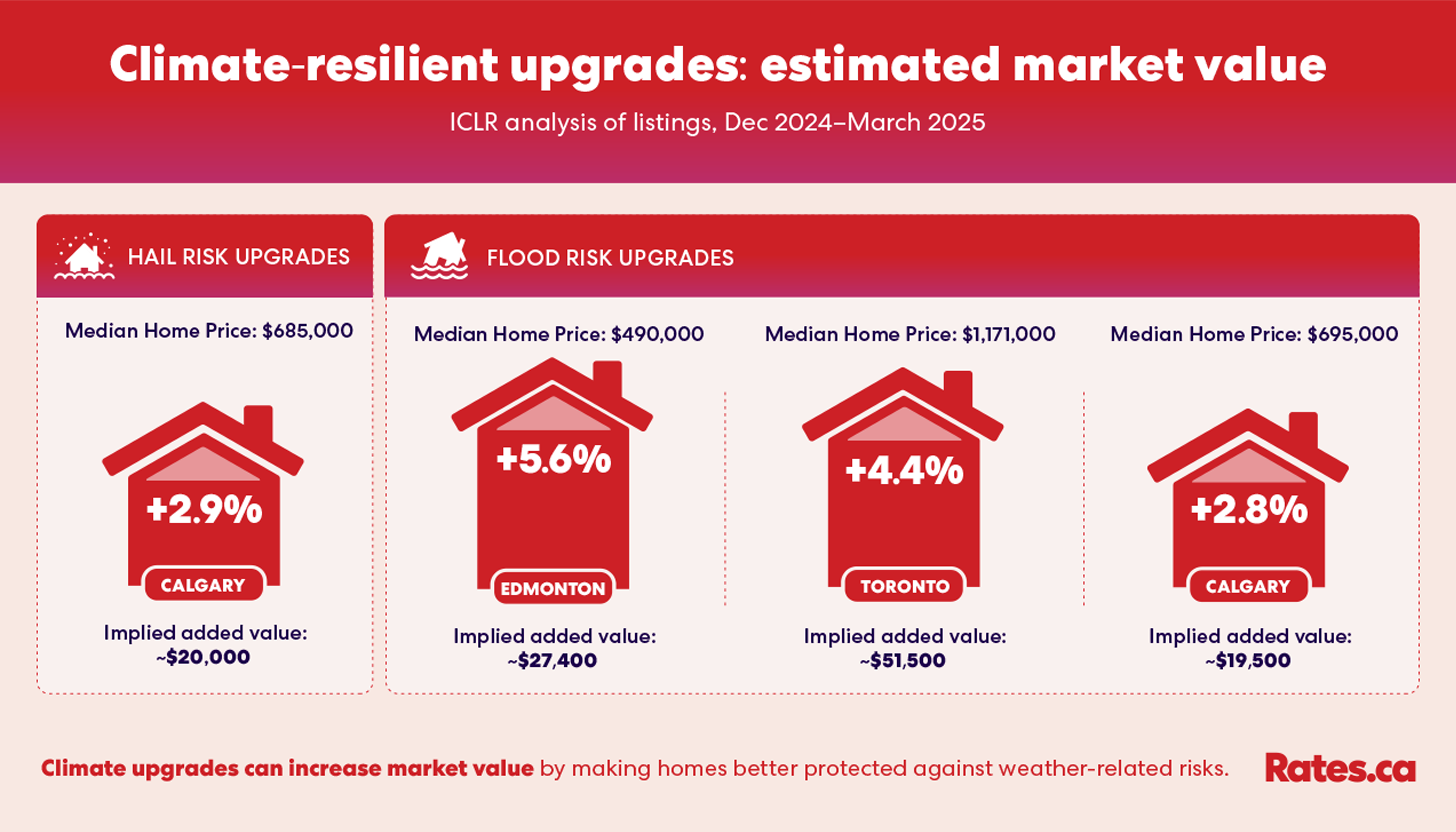
Most of these additions, such as sump pumps, backwater valves, or hail-resistant shingles, typically cost between $3,000–10,000, according to the ICLR study. Homeowners could receive a return on investment for these installations prior to selling.
“I was surprised that there was evidence that resilience did affect property resale prices,” says Dan Sandink, senior director of resilience programs at ICLR in Toronto and co-author of the study.
“And I was also surprised that there was even mention of resilience measures in real estate ads to begin with. But it’s a sign, a positive sign,” he adds.
The researchers note that study findings are considered to be early signals rather than precise market-wide estimates. Some cities had only a handful of listings highlighting weather related installations, and in a few cases, only asking prices were available.
Majority of Canadian homeowners would pay for upgrades, if explained
Many homeowners say they face severe weather risks, but far fewer act on them. However, when people understand what resilience additions are, and what problems they prevent, interest rises quickly.
A Leger survey of 1,073 homeowners across Canada conducted for Rates.ca in March found that 56% of Canadian homeowners would be willing to pay more for a home with sump pumps with battery backup, stronger roof shingles, or better drainage. Another 20% said they hadn’t made up their minds, leaving room for demand to grow with clearer information.
Among those willing to pay more, spending thresholds were substantial:
- 26% would pay up to $5,000 more
- 20% would pay $5,000–10,000 more
- 6% would pay $10,000 or more, including 4% willing to spend $20,000+
The findings point to a clear gap. While 86% of homeowners believe homes face extreme weather risks, three in five (59%) say they have not installed, and do not plan to add, any protective measures. The issue isn’t indifference, it’s clarity. Buyers often don’t know what protective measures and rebates are available, what they do, or why it matters.
Flooding tops the list of perceived threats nationwide, followed by high winds, wildfire, heavy rain, and hail. When homeowners can connect a familiar risk to a specific fix, they’re more open to paying for it. Hence price premiums show up once those features are built into homes and clearly explained.
Why awareness flips to action
Willingness to invest in upgrades is shaped by how people perceive their own risk exposure—and most underestimate it. As Sandink notes, “Most homeowners have no idea what the technical components of their building are. They usually assume flood protection is already covered through government requirements.”
Public awareness often lags reality. “Even in high-risk flood-prone areas, we know that 90% of people don’t know they’re exposed to flooding, if they’re in a floodplain,” Sandink says.
This gap explains why resilient homes command a premium in some markets. In other areas, buyers overlook renovations because they don’t recognize risks those features address.
What home improvements do buyers recognize in high-risk markets?
Here are features that appeared most often in listings tied to price premiums or prioritized by buyers once risks were explained, according to the ICLR study:
- Hail (Calgary and the Prairies
- Flood (Toronto, Edmonton, Halifax)
- High wind (GTA and Atlantic Canada)
- Wildfire (B.C. Interior and Alberta)
For more insights from the study and a complete write-up of the results, please refer to the original Rates.ca release, “Severe weather adaptations boost home value by up to 5.6% in Canada.”
More information:
- How to protect your home from severe weather
- Is severe flooding making your home uninsurable?
- How to lower home insurance rates by keeping your home in good shape
About RATES.ca
Rates.ca is Canada’s leading insurance rate comparison platform, dedicated to providing seamless, digital-first experiences for Canadians. Based in Toronto, Ontario, Rates.ca has been a trusted name in the auto insurance industry for over 20 years, serving more than five million Canadians annually. As an industry pioneer, Rates.ca revolutionized the market by being the first to introduce online tools that allow users to compare over 50 auto and home insurance quotes instantly. For more information, visit rates.ca.
About Pollara Strategic Insights
Founded in 1985, Pollara Strategic Insights is a Canadian public opinion and market research firm that provides custom quantitative and qualitative research as well as a suite of proprietary research models and syndicated studies. Pollara Strategic Insights is a founding, accredited Gold Seal member of the Canadian Research Insights Council (CRIC). They are in full compliance with the CRIC Canadian Code of Market, Opinion, and Social Research and Data Analytics, the CRIC Public Opinion Research Standards and Disclosure Requirements, the CRIC Pledge to Canadians and ISO 20252:2019.
Source: Rates.ca Group Ltd.
Tags: home insurance, Institute for Catastrophic Loss Reduction (ICLR), Rates.ca, resilience, severe weather


